In this guide · 8 sections
The short answer
- Odd numbers: three pieces for most shelves, five for a long mantel or a broad console.
- Anchor first: the largest piece sets the scale, so buy it first and choose the rest against it.
- Clear size steps: an Extra Large at 14 inches with a Small at 7.25 and a Mini at 4.5 reads better than a Medium with two Smalls.
- Mix the finish: pair a check with a stripe rather than one check at three sizes.
- Check the exact Medium: widths run from 9 inches on the check Mediums to 11 inches on the Courtly Check Glossy.
The question we get more than any other in autumn is some version of this: there are already two pumpkins on the mantel, so what should the third one be? Bigger or smaller? Matching or not? Almost always the answer comes down to MacKenzie-Childs pumpkin sizes, and to how far apart the three pieces sit.
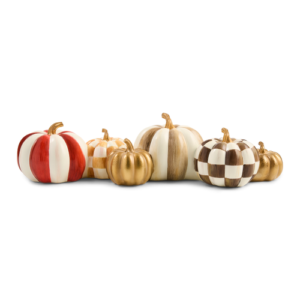
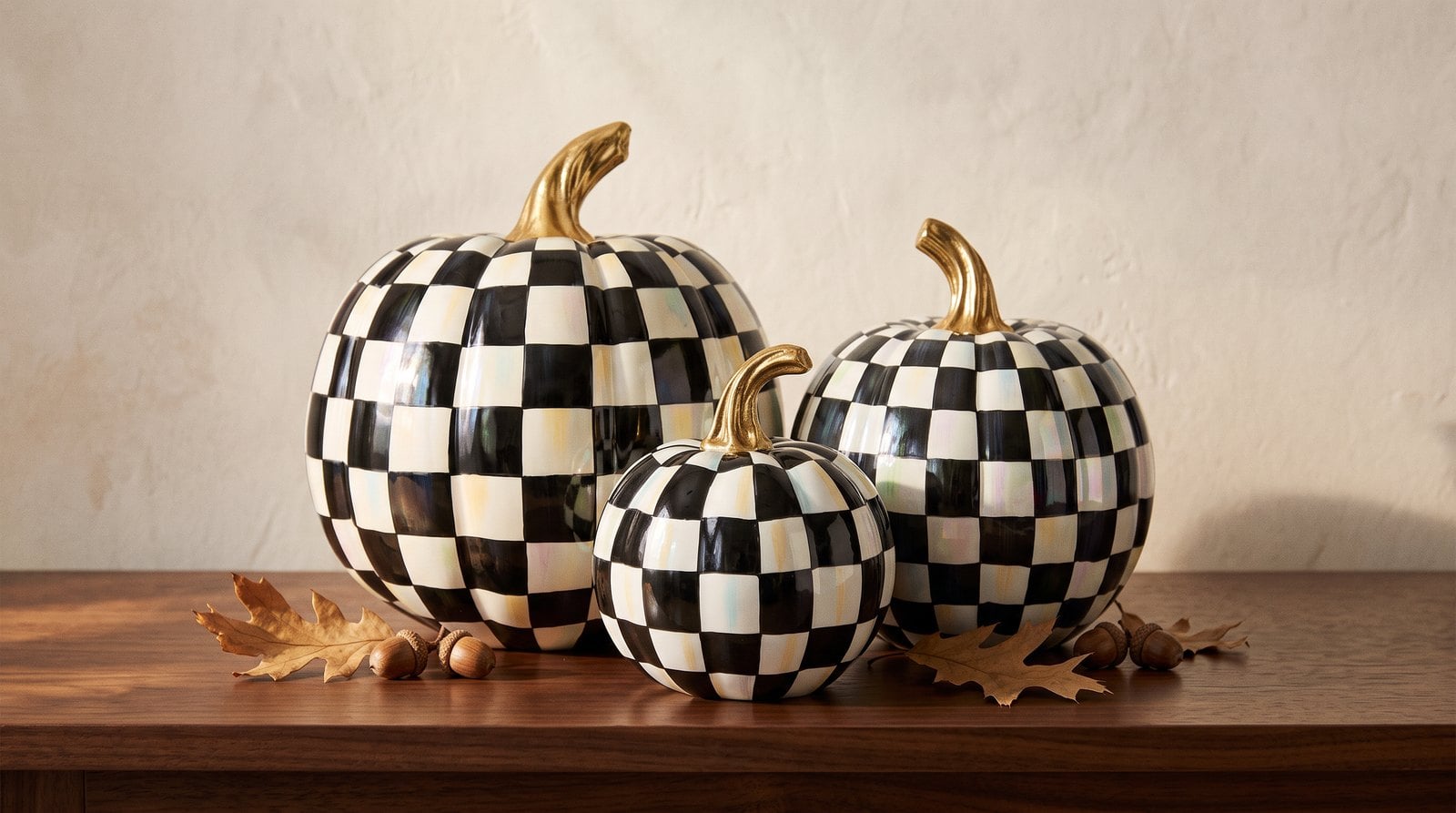
A single MacKenzie-Childs pumpkin is a lovely object. A group of them is a decision, and it is the grouping that people get wrong. The sizes run from a four-inch petite to a twenty-one-inch jumbo, a wide enough spread that two pieces chosen without thinking rarely sit well together. Two similar pumpkins side by side read as a matched set that is missing its third piece. Three chosen well look deliberate, and they hold a mantel or a console for the whole season.
Here is how we build them in the shop, and the size information you need to do it at home. Before you order, please read our return policy: holiday decorations are final and cannot be exchanged, refunded or price adjusted. Getting the group right the first time matters more here than with most purchases.
The four rules of a cluster that works
Group in odd numbers. Three is the workhorse. Five if you have a long mantel or a broad console. Even numbers pair off and the eye keeps looking for the missing piece.
Choose one anchor and commit to it. The largest piece sets the scale of everything else. Buy it first, live with it for a week, then choose what goes beside it. Buying three at once is how people end up with three objects that do not talk to each other.
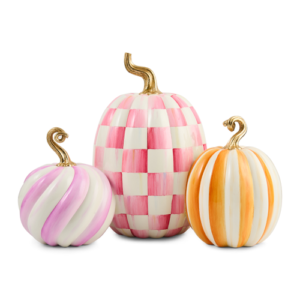
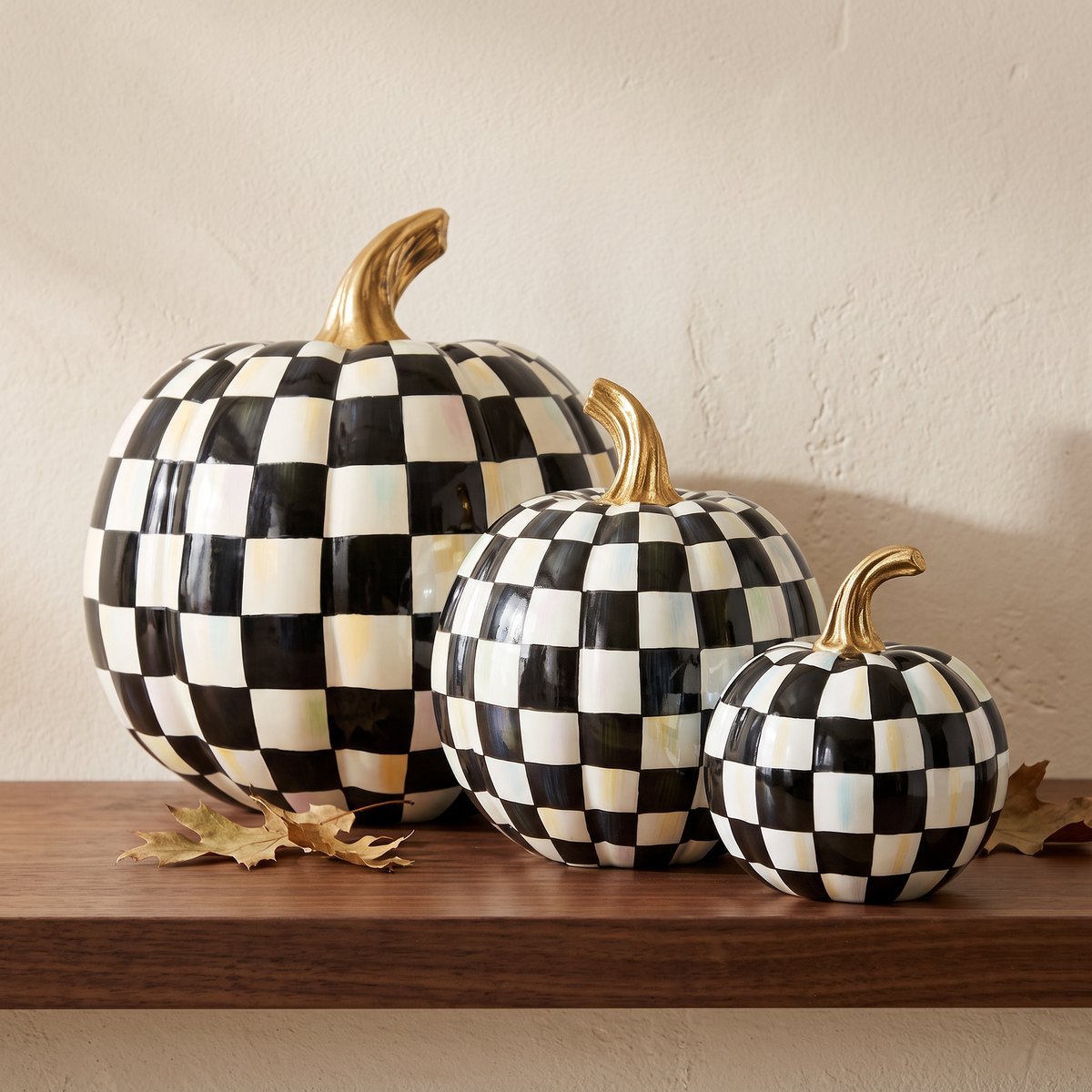
Make the size steps obvious. This is the rule people break most often. Everything after the anchor should be clearly smaller, not slightly smaller. An Extra Large at 14″ wide with a Small at 7.25″ and a Mini at 4.5″ gives you a group with real hierarchy, because each step down is unmistakable. A Medium with two Smalls is a closer call, and in our experience the 9″ and 7.25″ widths sit near enough that the group can read as indecisive rather than layered.
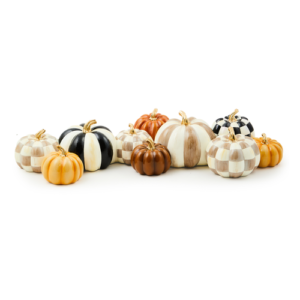
Vary the finish, not just the size. If your anchor is a check, bring in a stripe rather than a second check. Repeating one finish at three sizes looks like a product lineup. Mixing check with stripe looks collected.
That third rule is the one that needs numbers behind it, which is where most people get stuck. MacKenzie-Childs publishes dimensions one product page at a time, so there is nowhere to see the sizes side by side. We built that chart from those product pages.
MacKenzie-Childs pumpkin sizes: the chart
Diameter first, then height, as the manufacturer’s own product pages give them.
| Size | Diameter | Height |
|---|---|---|
| Mini | 4.5″ | 6″ |
| Small | 7.25″ | 8″ |
| Medium | 9″, or 11″ for Courtly Check Glossy | 11″ |
| Large | 13″ | 17″ |
| Extra Large | 14″ | 12″ |
| Jumbo | 21″ | 18″ |
Because MacKenzie-Childs lists dimensions per product rather than per size, always confirm against the exact colorway you intend to buy.
The ladder is not a straight line, and this matters for your anchor. The Extra Large is wider than the Large, 14″ against 13″, but five inches shorter at 12″ against 17″. If you assume the names run in order you will choose the wrong anchor. Extra Large is not a taller Large; it is a broader, squatter object. From that rung upward the pumpkins are wider than they are tall, which is what makes them floor and hearth pieces rather than tabletop ones.
The step from Mini to Small is larger than people expect, nearly three inches of diameter and two of height. On a shelf the Mini reads as a small object you pick up, while the Small reads as decor. If you are deciding between the MacKenzie-Childs Mini and Small pumpkin for the smallest piece in your group, that is the honest difference. Not a couple of inches, but two different jobs.
The Large is the tallest piece below the Jumbo at 17″, six inches taller than a Medium and, at 13″ across, genuinely wider than either Medium. It is a vertical anchor, and its height is the point.
Not every Medium is the same size
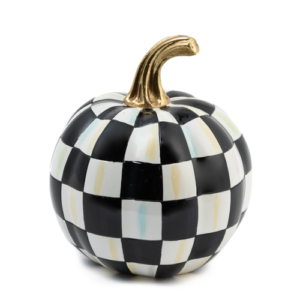
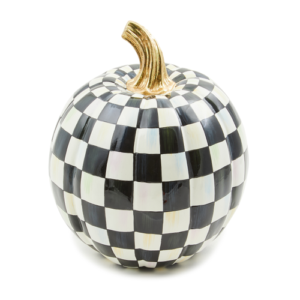
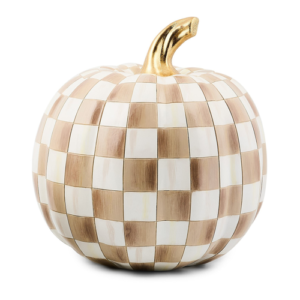
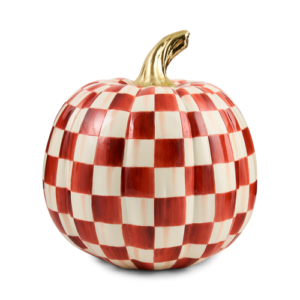
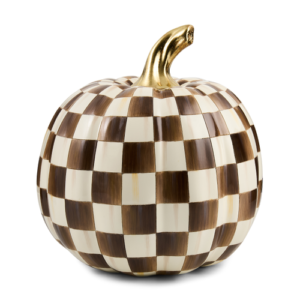
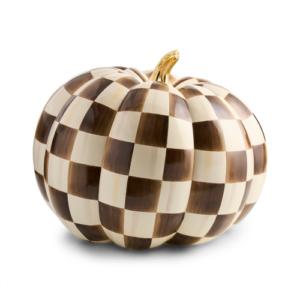
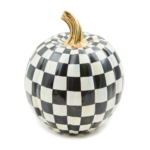
Medium is not one measurement. The Mocha Check, Paprika Check and Chocolate Check Mediums are all listed at 9″ diameter by 11″ tall. The Courtly Check Glossy Medium is listed at 11″ diameter by 11″ tall. Same size name, two inches of difference in width, and two inches on a nine-inch object is a great deal. Set them side by side and one is visibly stouter.
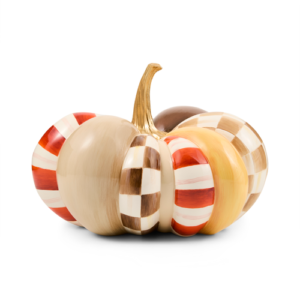
It goes further. The Harvest Glow Patchwork Medium is 11.5″ wide by 7.5″ tall, a Medium that is wider than it is tall and three and a half inches shorter than the check Mediums. It is a different shape of object wearing the same size name.
We have no explanation for the variation beyond different sculpts and production runs. The practical point stands either way. If you are adding a second Medium beside one you already own and you want them to read as a pair, open the product page for that specific colorway and read its dimensions rather than trusting the label.
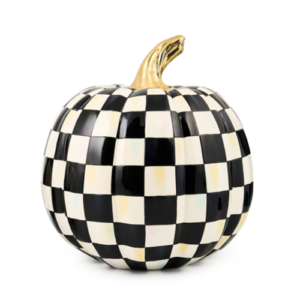
The four check Mediums we stock are the Courtly Check Glossy Medium Pumpkin at 11″ by 11″, and the Mocha Check Medium Pumpkin, Paprika Check Medium Pumpkin and Chocolate Check Medium Pumpkin at 9″ by 11″. The Harvest Glow Patchwork Medium Pumpkin is the low, wide one described above.
A note on the Large
The Large, at 13″ by 17″, is a real size in the range and we have kept it in the chart so the ladder is complete and so you can place a Large you may already own. We are not currently stocking one. If you want that tall, narrow silhouette from what we carry, the Medium at 11″ tall is the closest. If you want scale, the Extra Large and Jumbo go wider rather than taller.
Choosing the anchor for your surface
The anchor should suit the surface before it suits the season. Everything else in the group follows from it.
Mantel, entry table or sideboard: a Medium. At 11″ tall it holds the center of a group without dominating the room. This is the size most people should buy first if they are only buying one thing.
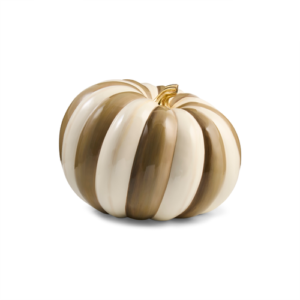
A hearth or a wide console: the Extra Large. At 14″ by 12″ it fills horizontally in a way a Medium cannot. The Mocha Stripe Extra Large Pumpkin is the widest piece that still works on a substantial table.
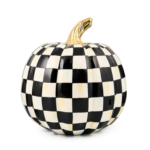
Floor, landing or the base of a staircase: the Jumbo. The Chocolate Check Jumbo Pumpkin at 21″ by 18″ is a room anchor rather than a tablescape one. It is not a dining table piece, since 21″ across takes the middle of most tables and leaves nowhere for the food.
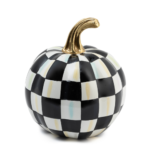
Then fill in beneath it. The Courtly Check Glossy Small Pumpkin at 7.25″ by 8″ is the natural second piece for a Medium or Extra Large anchor, holding its own spot without demanding one. The Courtly Check Glossy Mini Pumpkin at 4.5″ by 6″ is the third. A Mini works at a place setting, on a bathroom counter or on a small shelf, but a single Mini on a long console reads as clutter, as though something got left there. Use Minis in threes or use them as the smallest step in a larger group.
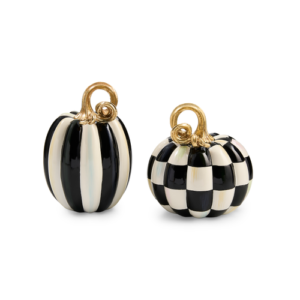
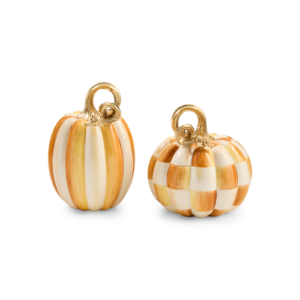
Smaller again are the petite sets, which are their own naming rather than a rung on the ladder. Each pairs two pumpkins at different heights, a shorter one at 4″ diameter by 4.5″ tall and a taller one at 3″ diameter by 5″ tall. The Courtly Check and Stripe Petite Pumpkins, Set of 2 and Amber Check and Stripe Petite Pumpkins, Set of 2 are useful twice over: they give you two of your three pieces already resolved in check and stripe, and on their own they suit a windowsill, a desk or an open shelf.
If you would rather not assemble one
Some groupings arrive already resolved. The Harvest Glow Pumpkin Cluster and the Autumnology Check & Stripe Pumpkin Cluster are composed pieces rather than loose groups, and they solve the problem in one purchase.
They are also the right answer for a dining table, where height is the constraint rather than width. The Autumnology cluster runs 17.75″ long and only 3.5″ tall, and the Harvest Glow cluster is 18″ long and 5″ tall. Both stay well below sightline, so people can see one another across the table.
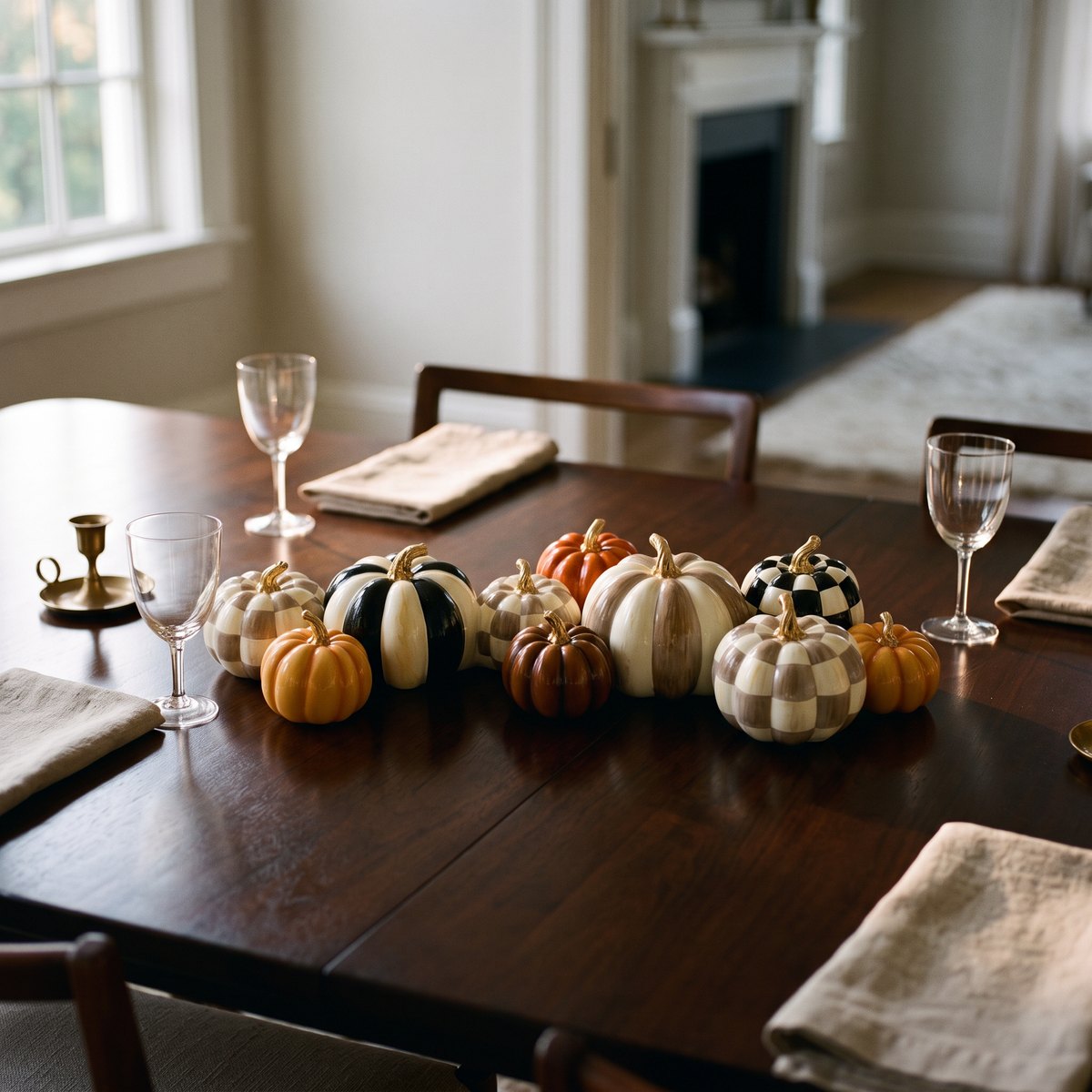
The Glam ‘O’ Ween Pumpkin Trio Centerpiece is a different proposition at 19″ long and 14.5″ tall, with the pumpkins set at varied heights. It is a striking piece, but at that height it will block sightlines across a dinner table. We would put it on a console, a sideboard or an entry table rather than between two people trying to talk.
Material, care, and the indoor question
They are resin. MacKenzie-Childs’ care instruction is to wipe with a soft, dry cloth. Beyond that, our own advice is to skip sprays and abrasives and keep water off the painted surface. That is our recommendation rather than a manufacturer instruction, but it is how we would treat a hand-finished piece of this kind.
Are MacKenzie-Childs pumpkins indoor or outdoor? Here we want to be precise, because it would be easy to imply something the manufacturer does not say.
MacKenzie-Childs does not describe the standard resin pumpkins as indoor only. Its own copy for the Chocolate Check Jumbo Pumpkin says the piece “will complement any Halloween homescape, indoors or out.” Outdoor use is not something the maker rules out.
At the same time, MacKenzie-Childs sells a separate outdoor range, and those pieces are specified differently: resin and fiberglass, protected with a weather-resistant polyurethane finish. The standard pumpkins are listed simply as resin, with no weather-resistance specification. The meaningful difference is in the materials.
Our recommendation as a shop, and this is our view rather than a MacKenzie-Childs statement, is to treat the standard resin pumpkins as indoor decor. Given a hand-finished piece that cannot be returned once it is yours, we would keep it out of sun, sprinklers and weather. A covered porch is a reasonable judgment call. Full exposure is not one we would make. If you want a pumpkin that lives outside for the season, the purpose-built outdoor range is the honest answer.
Choosing colorways for a long autumn
Once the sizes are settled, the colorway decides how long your group stays out.
Warm harvest tones, the Ambers, Paprikas, Chocolates and Mochas, carry from early September through Thanksgiving without changing character. They read as autumn rather than as Halloween, so the group you set out now is still doing its job at the end of November. That is close to three months.
Halloween-forward colorways put themselves away on the first of November. That is not a criticism, since some of the best pieces are the Halloween ones, and if you love one, buy it. Just know you are buying roughly nine weeks of display rather than twelve.
For a first cluster we would start warm. A Chocolate Check Medium Pumpkin or Paprika Check Medium Pumpkin makes a dependable anchor, and a check-and-stripe petite set gives you the contrast without a second decision. If you are extending a group you already own, a stripe in a warm tone is the safest addition to a shelf of checks. If the shelf in question is a Courtly Check one, our guide to the Courtly Check pattern covers how the black and white reads against warmer colorways. The Harvest Glow Patchwork Medium Pumpkin goes the other way, busy enough that it wants quiet company rather than more pattern.
One last piece of advice, and it costs nothing. Before you order, measure the surface and mark the diameter and height of each piece on it with paper. Standing paper circles where the pumpkins will go answers the hierarchy question faster than any chart can.